
Budapest's Hidden Jewel Box: Szervita Square
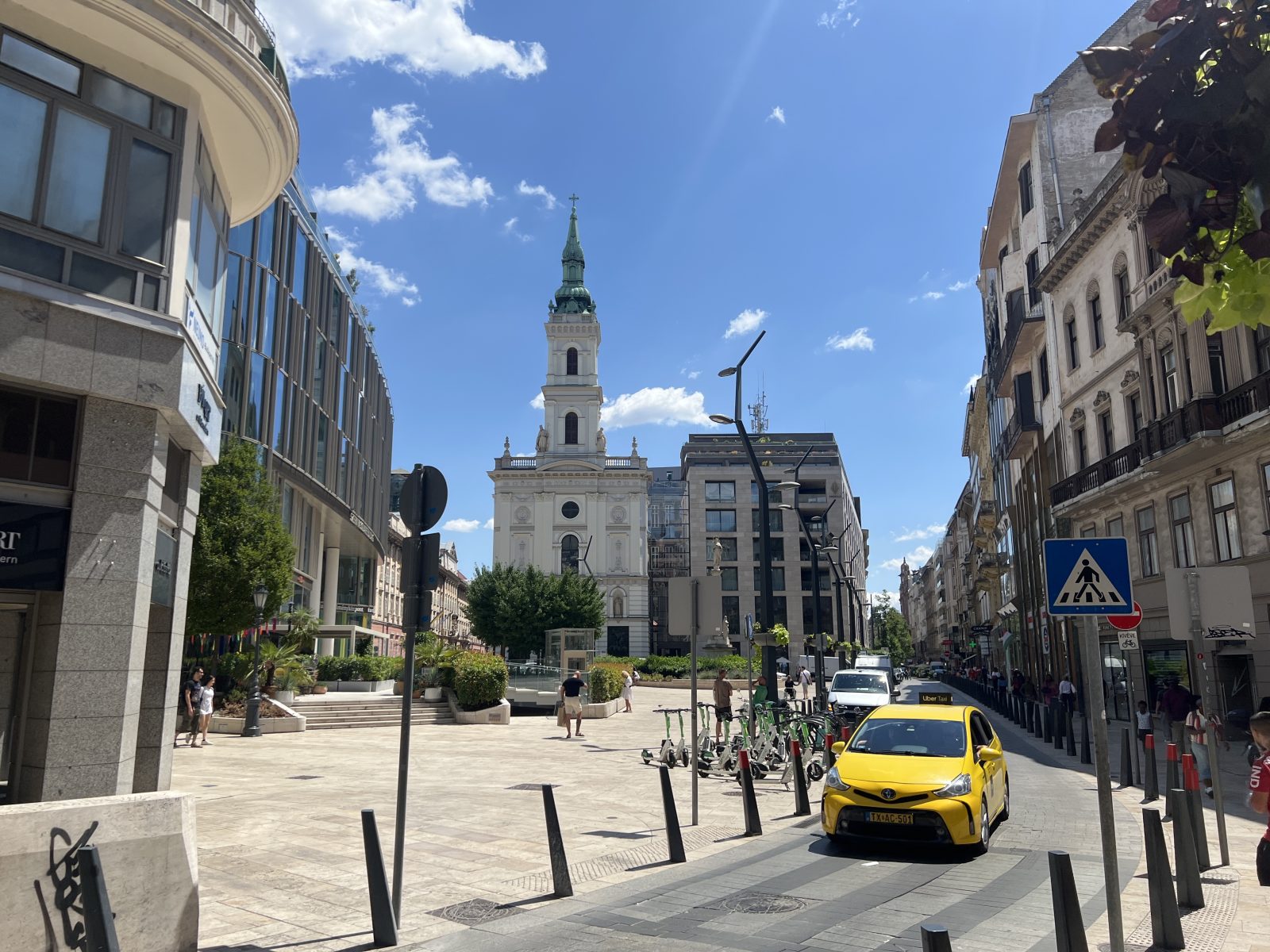
Budapest's Hidden Jewel Box: The History and Architectural Masterpieces of Szervita Square
In the heart of Downtown Budapest, just a few steps from bustling Váci Street and Deák Square, lies one of the capital's most atmospheric and architecturally diverse squares, Szervita Square. Although small in size, this square is a virtual open-air museum of Hungarian architectural history, where lush 18th-century Baroque, elegant early 20th-century Art Nouveau, and the most modern contemporary architecture coexist in perfect harmony.
The History and Name of the Square
The history of the square dates back to the period following the Ottoman occupation. After Buda and Pest were liberated from Ottoman rule in 1686, Catholic religious orders began settling one after another in the ruined city. Among them were the Servites (Order of Servants of Mary), who received permission in 1689 to build a monastery and a church in this area. The square was named after them, and although its name changed several times throughout history (it was once called Town Hall Square and White Friars Square), it eventually regained its original, prestigious name.
Architectural Styles and Must-See Attractions
What makes Szervita Square special is that almost every building represents a unique style, showcasing the most important periods of Pest's development.
1. Inner City Parish Church of St. Anne (Servite Church)
The oldest and most dominant building on the square is the Roman Catholic St. Anne's Church. Construction began in 1725 and was completed in 1732, designed by János Hölbling. The church and its adjoining monastery are among the finest examples of Budapest's Baroque architecture.
Interesting fact: Today, the church's facade does not reflect its original 18th-century appearance. In 1871, it was rebuilt in an Eclectic style based on the designs of József Diescher, and then, following damage sustained in World War II, efforts were made in the mid-20th century to restore its original Baroque look. The St. Anne statue group on the facade and the bullet holes embedded in the walls still serve as reminders of the fighting in Pest during the 1848–49 Revolution and War of Independence.
2. The Török Bank House (3 Szervita Square)
Rising on the northern side of the square is one of the most outstanding masterpieces of Hungarian Art Nouveau architecture, the former Török Bank House. Designed by Henrik Böhm and Ármin Hegedűs, the building was opened in 1906.
The main adornment of the facade is the massive mosaic on the pediment, created by the brilliant glass artist of the era, Miksa Róth, based on the designs of Károly Kernstok. Entitled "The Glorification of Hungaria", the monumental mosaic depicts Patrona Hungariae (the Virgin Mary, patron saint of Hungary) on her throne, with prominent figures of Hungarian history paying homage to her.
Interesting fact: Many believe the building has a connection to Turkey (as "török" means Turkish in Hungarian). In reality, it was named after the banking firm A. Török & Co., which founded the bank and was one of the most prominent financial institutions of the era.
3. The Rózsavölgyi House (5 Szervita Square)
Standing right next to the church is a pioneering work of Hungarian pre-modern architecture, the Rózsavölgyi House. It was built in 1911–1912 based on the designs of the brilliant Béla Lajta.
Lajta broke away from the heavily decorated Historicist styles of the past to create a commercial and residential building with clean, geometric lines. The delicate ceramic decorations with Hungarian motifs adorning the facade, along with the undulating storefronts, are brilliant examples of blending cosmopolitan Pest with traditional folk motifs.
Interesting fact: The famous Rózsavölgyi & Co. music store still operates on the ground floor of the building today, having served as one of the capital's most important cultural meeting points for over a century.
The Modern Rebirth of the Square
For decades, Szervita Square suffered from the eyesore of an incongruous telephone exchange and parking garage built during the socialist era. By the 2020s, however, the square was completely revitalized. In place of the old concrete monstrosity, the Szervita Square Building (Emerald Residence) was built—a highly modern luxury residential and office building covered in reflective glass surfaces.
Balthough the modern development divided public opinion, there is no doubt that the Baroque church tower and Art Nouveau mosaics reflected in the building's glass walls offer a unique, futuristic sight, bridging the past and the present.
Why You Should Visit
- Architectural time travel: You can photograph Baroque, Art Nouveau, pre-modern, and contemporary architecture all within a single small square.
- Cultural experiences: Whether browsing the Rózsavölgyi bookstore or listening to an organ concert at St. Anne's Church, you can enjoy a truly enriching cultural experience.
- Central location: An excellent starting point or resting spot during a walk downtown, where cozy cafes await visitors.
Media Group and Partners: AutoMotorCenter.hu | BPszakik.hu | MyBalcsi.hu | TRSOnline.hu | KarikuszDesign.hu | Holszorakozz.hu | Autosjatekok.hu | BMWShow.hu | Rallyhungary.hu | Holszorakozz.hu | Kidblo.com I Kidblo.hu | Máltainyaralás |