


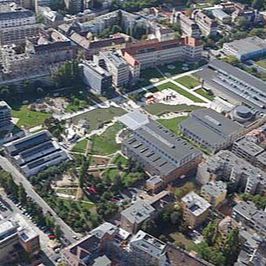
Story
Ábrahám Ganz founded his foundry in Buda in 1844, where the Foundry Museum is today. The small plant grew into a major engineering company in less than one man's life. After Ganz's death, the factory quickly rose to the top of the domestic factories thanks to the development activities of the highly skilled mechanical engineer András Mechwart. In 1878, Mechwart established the electrical department within the framework of Ganz és Társa Vasöntő és Gépgyár Rt., which created the foundations of the high-current electrical industry, and entrusted the management of it to the young and agile Károly Zipernowsky, who deals with the latest results of electrical engineering. The small workshop, first in a courtyard building on Kacsa utca in the second district, then in the Fő utca building of the former Király mill, developed into a real factory, one of the continent's most important electricity factories.
The initial successes were crowned by the transformer system developed by Károly Zipernowsky, Titusz Bláthy Ottó and Miksa Déri in 1884-85, and by the creation of the first transformer in 1885 (which made it possible to transport electricity over longer distances for the first time). The Ganz factory soon became known worldwide for its production of electrical systems, and its electrotechnical products and equipment became one of the leaders of the world market for two decades. The era is also characterized by a series of inventions used worldwide, including, for example, the electric consumption meter designed and patented by Bláthy, the "electric clock", but also the developments of the electric traction system attributed to Kálmán Kandó.
The Lövőház Street building of the then world-class electrotechnical factory was built in 1897, where more than two thousand people worked at that time. In 1906, the factory became independent and operated under the name of Ganz's Electric Power Company until 1929, when - under severe pressure from international competitors and its professional prestige damaged - it merged back into the parent factory. In the meantime, in 1911-12, the large workshop was built, which today is included in the list of industrial monuments, preserving the spirit of the place for the future as a monument of the national industrial and cultural heritage.
Ganz achieved new recognition and success as a leading company in domestic electrification, which started in the 1920s, and then, as a result of its successful modernizations, it was able to record international successes again for a short time. The company recovered from the crisis with the Kandó system locomotives of the railway electrification, the Ratkovszky voltage regulators, and the various Jendrassik engines and turbines, but everything was soon destroyed by the devastating effects of World War II.
The factory, which was rebuilt with many difficulties, became independent again in 1949 under the name Ganz Electricity Factory, and then, after undergoing numerous organizational changes, its name became Ganz Electricity Works in 1963. The large company produced for an increasingly narrowed market, and the missed substantial developments set it back significantly, although the company still kept its old name with some competitive products on the international market. The reduction of own development, the gradual falling behind the world standard, then the decrease in efficiency, and last but not least, the reorganization of the markets, pushed the company with a long history into a crisis situation.
The establishment of Ganz Ansaldo Electricity Company in 1991 with the involvement of foreign capital represented a temporary way out, but production gradually decreased, and then the relocation of the capital plant to the countryside began. From 2000, the electricity company continued to operate under the name Ganz Transelektro Rt. At the same time, work aimed at creating the Millenáris Park began at the former central factory.
Source: Wikipedia
There are no reviews at the moment
- Országút, Budapest 1024, Hungary

Vajdahunyad Castle (Hungarian: Vajdahunyad vára) is a castle in the City Park of Budapest, Hungary. It was built in 1896 as part of the Millennial Exhibition which celebrated the 1,000 years…

Komplett arculattervezéstől a rendezvényszervezésig...

Public Toilet – Határ Road Underpass
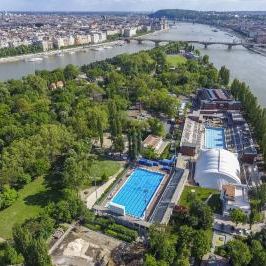
Margaret Island (Hungarian: Margit-sziget [ˈmɒrɡit.siɡɛt]; German: Margareteninsel; Turkish: Kızadası) is a 2.5 km (1.6 mi) long island, 500 metres (550 yards) wide, (0.965 km2 (238…

The place is currently clearly a rocker pub in the modern sense of the word, harder music is played from the computer, Rammstein, thrash metal, hardcore, although the music is loud, but not…
Public Toilet Ady Endre Street 7
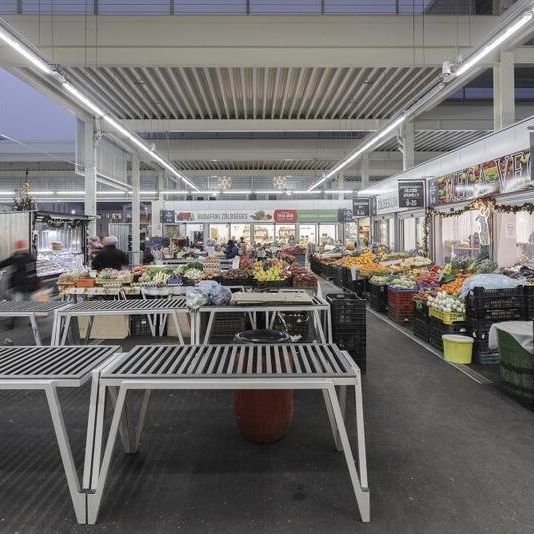
Public Toilet Budafok Szomszédok Market
Public Toilet – Zugló Railway Station
Media Group and Partners: AutoMotorCenter.hu | BPszakik.hu | MyBalcsi.hu | TRSOnline.hu | KarikuszDesign.hu | Holszorakozz.hu | Autosjatekok.hu | BMWShow.hu | Rallyhungary.hu | Holszorakozz.hu | Kidblo.com I Kidblo.hu | Máltainyaralás |


Millenáris Park